
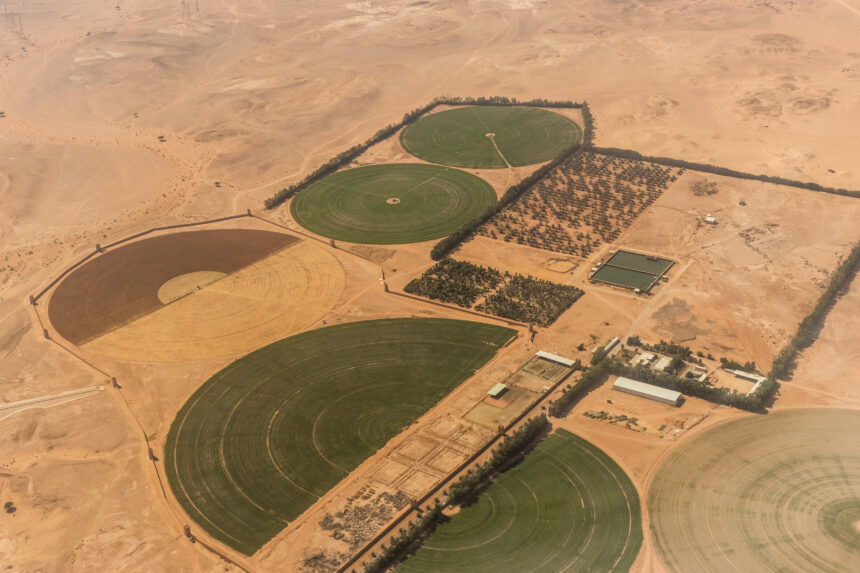
- Control with water or nurture with soil?
It’s possible to farm in the desert.
That’s already been proven.
Giant sprinklers.
Pumping groundwater and circular farmland.
Crops that grow in a short period of time.
But one question remains:
Is this “agriculture that thrives with the desert”?
Or is it “agriculture that tries to overcome the desert”?
Two types of agriculture in the desert
In the second half of the 20th century,
countries such as Saudi Arabia
successfully implemented large-scale desert agriculture.
Aerial photographs show perfect circles.
This farmland was irrigated with center-pivot irrigation.
Water was pumped up from deep underground,
and crops were grown all at once.
In the short term, it was a success.
But it didn’t last.
Water levels dropped,
costs rose,
and eventually much of the farmland fell into disuse.
The crops grew, but the land did not.
The limits of water-based agriculture
The essence of this method is this:
– Provide large amounts of water
– Add nutrients from outside
– Maintain production through management
This is industrial agriculture,
and the concept is similar to hydroponics.
The moment the water is stopped,
it’s all over.
The land
is left with no ability to sustain itself.
Another option
On the other hand, there is agriculture with a completely different philosophy.
That is agriculture that “does not try to change the desert.”
A prime example is
Israel.
Israel
did not try to turn the desert back into forest.
– Watering is kept to a minimum
– Watering is limited to certain areas
– Soil is “something to be created”
They created structures that allow people to survive in the desert.
Still,
this method has its limitations.
Dependence on water will never completely disappear.
What is "Desert Agriculture"?
So, what exactly is desert agriculture?
It’s not agriculture that consumes water, but agriculture that nourishes the soil.
The key isn’t “what to plant,” but “in what order do you introduce living things?”
Living in the desert: the right order
1. Grass – Stops Sand
Crops aren’t the first thing you need.
Grass
-Prevents sand from blowing away
-Softens sunlight
-Protects the ground
Harvesting isn’t the goal.
It exists to improve the environment.
② Hemp - Moving the soil
Next up is hemp.
Hemp
– Spreads deep roots
– Loosens the soil
– Turns into organic matter when cut and sown back.
Hemp isn’t a crop.
It’s a soil-building device.
Here, the sand begins to transform.
3. Trees – anchoring the environment
Add the trees last.
Trees
-Stop the wind
-Provide shade
-Drop leaves
Trees act as pillars to protect the soil.
Crops are the last
This is where many failures lie.
Crops are planted from the beginning.
They are nurtured with water and fertilizer.
It only “appears to grow.”
The land has not learned anything.
Crops are “guests” who arrive after the soil has been prepared,
not the “artisans” who create the soil.
The desert reflects the attitude of civilization
The desert is honest.
– If you force water, it will wither.
– If you take the time to nurture the soil, it will respond.
The desert
reflects human impatience and patience.
Conclusion
Agriculture that coexists with the desert
– Does not dominate with water
– Does not seek short-term results
– Passes the soil on to the next generation
It is possible to make the desert green.
However,
greening that does not betray the land
will only remain in places where the soil was nurtured.
The desert is not the enemy.
It is a mirror of a civilization with flawed design.